About us
Created in 1998 by young researchers in fluid mechanics, OPTIFLOW is:
A scientific culture and advanced technologies…
… for services adapted to our customers.
Our areas of expertise
Wind Engineering
20 years of experience in the field of wind engineering and building ventilation
Scientific Data Analysis
Flow physics interpretation for architectural project designers
Mathematical Modeling
Mathematical formulation of complex aeraulic phenomena and their interactions
Building Physics
Strong knowledge of the different heat exchange modes and their mathematical models
HPC Computation
HPC platform specially designed for CFD simulations
3D Modeling
Detailed 3D model construction from the data provided by our customers (from floor plans to 3D models coming from different tools...)
CFD, what is it?
Computational fluid dynamics (CFD) uses numerical analysis to solve and analyze problems that involve fluid flows in specific environments.
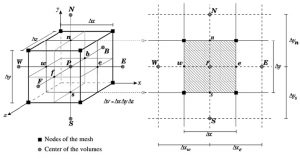
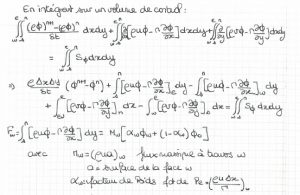
All phenomena related to fluid movements are governed by a system of partial differential equations called the “Navier-Stokes equations”, which have no general mathematical solution to date. There are, however, numerical methods for evaluating, in an approximate way, the value of their solutions at points defined in a given volume and under fixed conditions.
While it has become much more widespread in recent years, it cannot, contrary to what software publishers often claim, be used as a black-box tool. It is imperative to keep in mind that it remains a scientific tool and must therefore be used with all the rigour required to achieve results representative of a physical reality.
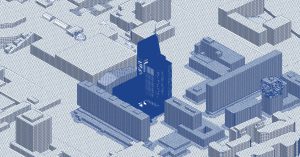
Using CFD to compute air flows around and within built structures, and even more specifically to determine wind loads, is particularly complex. It requires a deep knowledge of the physics of the phenomena (thermal transfer, random and highly turbulent nature of the wind…), specific developments (wind generation, aeraulic/thermal coupling, dedicated post-processing…) but also very large computing resources (several days of computation on a cluster of several hundred cores are required for some simulations).
With more than 20 years of experience, a strong knowledge of the physical phenomena studied and of the mathematical methods used to reproduce them, and a permanent scientific watch through participation in research programs, OPTIFLOW is today a company recognized for its expertise in applying CFD to architecture and urban areas.